You're pressing overhead, cranking out pull-ups, or grinding through the last few reps of bench when you hear it…a click, pop, or grind coming from your shoulder.
No pain. Just noise.
Now you're wondering: Should I be worried?
If you've Googled "shoulder clicking" after a workout, you're not alone. It's one of the most common things active adults notice, especially once you're regularly lifting, pressing overhead, throwing, golfing, or playing pickleball.
The good news? In most cases, shoulder clicking isn't a sign of damage. But there are situations where it's worth paying attention to.
Let's break down why shoulder clicking happens, when it's completely normal, and when it's a good idea to have it evaluated.
Why Does Your Shoulder Click?
Here's a helpful way to think about it: tendons don't always glide over bone in perfectly straight lines. Sometimes they are more like a guitar string being plucked slightly off-center. There's a small shift in tension as the string moves, and sometimes that creates a sound. It doesn't mean the string is damaged, it means it's doing what strings naturally do when they move under tension.
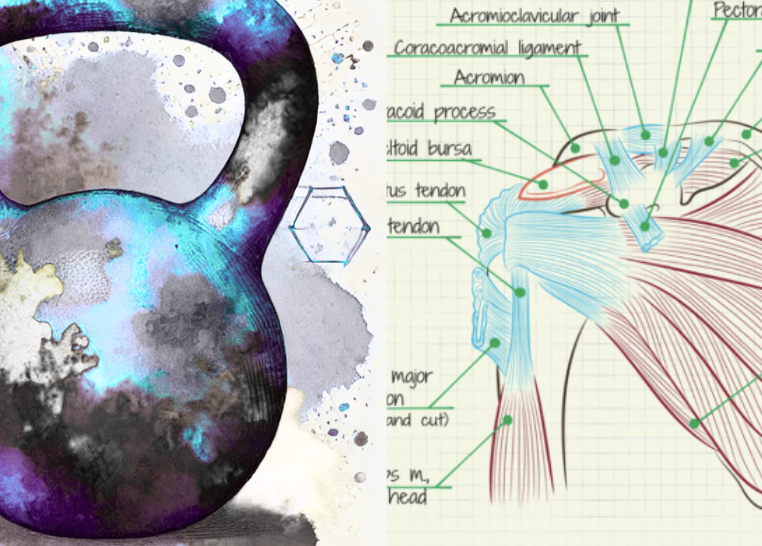
Your shoulder works much the same way. As you raise your arm, several tendons glide over bony landmarks while muscles contract and relax to control the movement. Sometimes those tissues shift just enough to create an audible click or pop.
In many cases, that's all you're hearing: normal movement, not damage.
Is Shoulder Clicking Without Pain Normal?
Yes, in most cases. Most shoulder clicking falls into this category: common, harmless, and especially common in people who train regularly. A few reasons your shoulder might make noise include:
Tendons shifting slightly over bone as your arm moves through space.
Small gas bubbles releasing within the joint fluid, similar to cracking your knuckles.
Minor scar tissue or soft tissue moving through a range of motion.
Individual anatomy…some people simply have joints that make more noise than others.
If your shoulder clicks without pain, weakness, instability, or loss of function, you're usually hearing normal mechanics rather than damage.
When Shoulder Clicking May Be a Sign That Something Needs Attention
The noise itself isn't the real signal, what comes with it is. Pay closer attention if clicking shows up alongside:
Pain, especially sharp or localized pain during the click
Loss of strength, like struggling to press a weight you normally handle fine
Instability, a feeling that your shoulder might slip or give out
Catching or locking, where the joint briefly gets stuck mid-movement
Reduced performance, meaning your lifts, reps, or range have quietly declined
Any one of these paired with clicking is worth exploring further. None of them mean something is torn or broken, they just mean your shoulder is asking for a closer look.
Why Active Adults Often Notice Clicking During Lifting
If you're regularly bench pressing, doing pull-ups, pressing overhead, snatching, or knocking out push-ups, you're putting your shoulder through repeated, loaded ranges of motion. That's exactly the kind of environment where clicking shows up more often, not because your mechanics are "bad," but because load and range expose whatever's already happening in the joint.
This is where a lot of well-meaning advice goes wrong. The instinct is to blame form: "your shoulder blade isn't moving right" or "you're pressing with poor mechanics." But mechanics aren't always inherently good or bad, they're either matched to the load you're asking your body to handle, or they're not yet.
Think of it less as a technique problem and more as a capacity problem. Rather than asking, "Is my form wrong?" ask, "Does my shoulder currently have the capacity for the load I'm asking it to handle?" A shoulder that clicks under a heavy bench press may tolerate lighter overhead pressing just fine. That isn't necessarily bad mechanics, it's your body showing you where its current tolerance ends.That's your tissue telling you where its current tolerance ends. The fix usually isn't "fix your form." It's building capacity so the same movement no longer exceeds what your shoulder can handle.
What Actually Causes Shoulder Clicking?
Instead of chasing a specific diagnosis, it's more useful to think about the factors that influence whether your shoulder clicks and whether that click matters:
Rotator cuff irritation, often from a mismatch between load and current tissue tolerance
Biceps tendon involvement, since it runs directly through the front of the shoulder and can contribute to noise during pressing or pulling
Scapular mechanics, meaning how well your shoulder blade sequences with arm movement (not "correct" vs. "incorrect," just more or less efficient for the task)
Mobility limitations, particularly in the thoracic spine or shoulder itself, which can change how load gets distributed
Strength deficits, especially in the muscles responsible for controlling the joint through bigger ranges
Load management, or how well your training volume and intensity match your body's current recovery capacity
Previous injury, which can leave subtle changes in tissue behavior even after you've "healed"
None of these automatically mean something is torn or permanently damaged. More often, they're simply factors that influence how your shoulder handles load and most respond well to progressive training.
Should You Stop Lifting?
In most cases, no. Pain-free clicking isn't a reason to back off bench, pull-ups, or overhead work. Stopping entirely often does more harm than good, since it reduces the very capacity you need to build to resolve the issue long-term.
If you're dealing with clicking specifically during bench press, or pain that shows up with it, our article on why your shoulder hurts when you bench press breaks down that particular pattern in more depth.
That said, if clicking comes with pain, instability, or a noticeable drop in performance, that's a good time to modify, not eliminate, your training while you figure out what your shoulder needs. This is where load management as a recovery skill becomes especially useful: adjusting volume and intensity temporarily, rather than shutting everything down.
It's also worth looking at the basics that influence tissue tolerance day to day. If sleep, stress, or nutrition have been inconsistent lately, check out the recovery triad, those factors affect how well your shoulder handles load even before you touch a bar. And if scapular mechanics are part of the picture, breathing patterns play a bigger role than most people expect; we cover that connection in harnessing the power of your breath.
When to See a Physical Therapist
Consider getting evaluated if:
Clicking is paired with pain, instability, catching, or locking
You've noticed a real drop in strength or performance
Symptoms have lingered despite modifying training or resting
You're unsure whether to keep pushing or scale back
Our guide on when to get help walks through how to tell the difference between something you can manage on your own and something that needs a professional eye.
At Empowered Athletics PT, we don't hand you a generic shoulder exercise sheet. We look at how your rotator cuff, scapular mechanics, mobility, and current load tolerance work together, then build a plan specific to your training, whether that's bench, pull-ups, snatches, or just reaching overhead without a second thought.
If your shoulder has been clicking for months, if it's starting to affect your confidence in the gym, or if you're never quite sure whether you should push through it or back off, that's exactly the kind of problem we help solve.
Schedule a Discovery Call with Empowered Athletics Physical Therapy in Laguna Niguel, and we'll help you figure out what's driving your symptoms and how to keep training without constantly second-guessing your shoulder.
FAQ
Is shoulder clicking normal?
Yes, in most cases. Pain-free clicking is common in active adults and usually reflects normal tendon movement, joint fluid dynamics, or individual anatomy rather than damage.
Why does my shoulder click when I bench press?
Often related to load exceeding current tissue tolerance in that specific range, not "bad mechanics." The same shoulder might handle other movements just fine.
What's the difference between shoulder clicking and shoulder grinding?
Clicking is usually a brief pop or snap; grinding (crepitus) is more of a continuous friction sensation. Grinding paired with pain deserves a closer look sooner.
Should I stop training if my shoulder clicks?
Not if it's pain-free. Continuing to train while monitoring symptoms is usually better than stopping altogether, since capacity-building is part of the solution.
When should I see a physical therapist for shoulder clicking?
If clicking comes with pain, instability, catching, locking, or a real drop in strength or performance, especially if it hasn't improved with basic self-management.