When to Get Help: A Smarter Approach to Pain and Performance
As an active, busy adult, it can feel easier to push through pain than to slow down and ask for help. You’ve got work, family, training, maybe a sport or CrossFit, and the idea of “taking a break” feels worse than the ache itself.
But here’s the truth: getting help early is one of the most performance-friendly decisions you can make.
It’s not about being fragile, it’s about being efficient.
In this post, you’ll learn:
Common “I’ll wait” mistakes active adults make with pain
Real-life style case examples of waiting vs. getting help early
What actually happens in a Rehab/Performance session (and why it’s not just “stretching and ice”)
How to know when it’s time to book a session or at least start a conversation
Why Active Adults Wait Too Long To Get Help
Most athletic, high-achieving adults don’t ignore pain because they don’t care.
They ignore it because:
They’re afraid a professional will tell them to “just stop” doing the things they love
They think it has to be bad enough or “a real injury” to justify a session
They’ve had past experiences where care felt generic and disconnected from performance
If that sounds familiar, you’re not alone.
The “I’ll Wait And See If It Goes Away” Trap
Here’s the typical pattern:
You notice a nagging pain (knee, shoulder, low back, Achilles, hip).
You modify here and there, maybe skip a warm-up, maybe pop some ibuprofen.
You tell yourself, “If it’s still here in a few weeks, I’ll deal with it.”
Training volume or intensity ramps up (new cycle, CrossFit Open prep, more cardio, more classes).
Suddenly, you’re not just sore…you’re changing how you move, avoiding certain lifts, or bailing on workouts completely.
By the time many athletes finally book a Rehab or Perform session, they’re not just dealing with pain.
They’re dealing with:
Loss of confidence in a lift or movement
Fear it’ll “blow up” at the worst possible time
Frustration and guilt about missed training or needing modifications
Waiting doesn’t just cost you physically; it costs you mentally and emotionally.
Common “I’ll Wait” Mistakes (And What To Do Instead)
Mistake 1: Only Reacting When Pain Hits A 7-10/10
If you only consider getting help when you’re limping, can’t sleep, or can’t train, you’ve already waited too long.
Smarter approach:
Treat persistent 3-5/10 pain as a yellow light, not background noise.
If something’s been nagging for more than 2-3 weeks without clear improvement, it’s worth at least a consult, even if you can still “push through” it.
Mistake 2: Hoping “Just Resting It” Will Fix The Problem
Rest can calm symptoms, but it doesn’t magically fix the reason your body got irritated in the first place (volume, mechanics, load management, recovery, etc.).
Smarter approach:
Think “reload and re-plan” rather than “just rest it.”
A good Rehab/Perform session should help you identify what to change in your training while staying as active as possible, not pull you out of your sport unnecessarily.
Mistake 3: Only Asking Dr. Google, Your ChatGPT Bestie, )r Your Gym Friends
The internet and your training buddies can be great for feeling less alone…but they can’t see your movement, your history, your actual week, or your priorities.
Smarter approach:
Use online information for context, not as your full plan.
Have at least one conversation with someone who understands both rehab and performance and can look at you, not just your symptoms.
Case Examples: Waiting VS Getting Help Early
Case 1: “It’s Probably Just Tightness”
An athletic adult notices some knee discomfort during squats and lunges. It’s annoying, but not unbearable.
They wait.
Week 1-2: They keep training as usual, maybe swapping one exercise here or there.
Week 3-4: Knee pain escalates during stairs, long days, and heavier sets. They start avoiding certain movements.
Week 5-6: Now they’re nervous before every lower body session, wondering if this is “the workout” that makes it much worse. Training gets inconsistent.
By the time they finally seek help, they’re frustrated, under-trained, and worried about “starting over.”
Alternate path: They get help early.
Week 1-2: Once they notice the pattern, they book a session.
In that session, they:
Get their squat pattern assessed
Identify where load, volume, or mechanics are aggravating the knee
Leave with a short, specific plan for warm-ups, exercise changes, and accessory work
Over the next 4-6 weeks, they still train, but with smarter choices…and the knee improves while they stay active.
Case 2: “I’ll Survive This Cycle, Then Deal With It”
A CrossFit/strength athlete notices shoulder discomfort in overhead pressing and gymnastics, but a new cycle just started.
They wait.
They push through, compensating with weird movement patterns.
Pain spreads to everyday activities (sleeping on that side, reaching overhead, long days at work).
By the end of the cycle, they’re not just dealing with a cranky shoulder, they’re also dealing with a confidence issue every time they see overhead work on the whiteboard.
Smarter scenario: They treat “small but persistent” as a cue to check in.
One Rehab/Perform session mid-cycle:
Clarifies what’s safe to keep doing
Simplifies what to temporarily dial back
Adds 1-2 key accessories or skill pieces tailored to their shoulder, not generic “shoulder health” exercises
They finish the cycle with better shoulder tolerance and clearer boundaries, not fear.
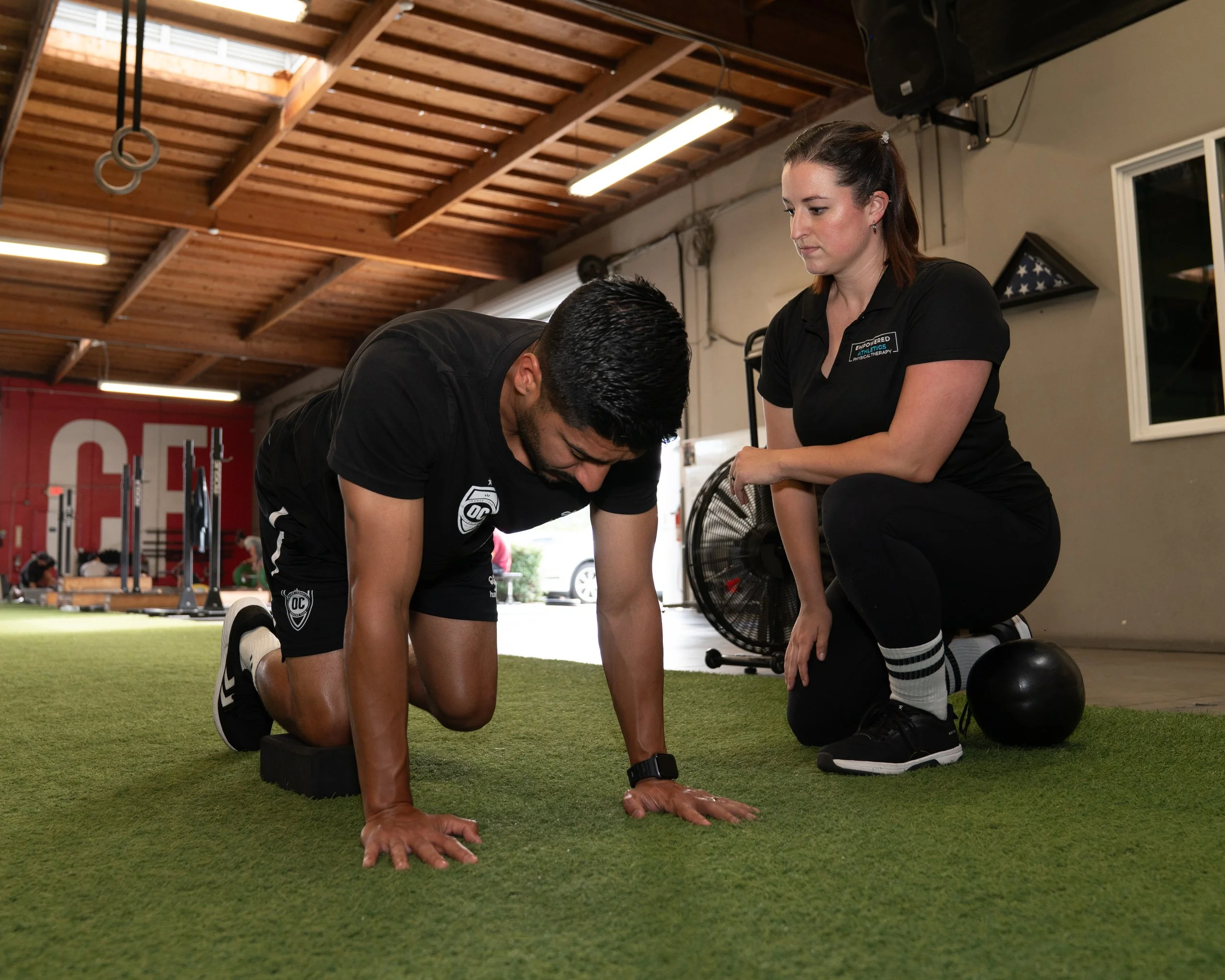
What actually happens in a Rehab/ Performance Session
If you’ve only ever experienced rushed or generic care, it makes sense you’d be hesitant to book.
A well-run Rehab or Perform session should feel like this:
1. Conversation About Your Real Life And Goals
Before jumping into tests or exercises, there’s a focused conversation:
What do you actually do in a typical training week?
What movements or positions make things better or worse?
What’s coming up (competitions, events, seasons, travel)?
What are you unwilling to give up if we can help it?
This context matters. The plan for a recreational runner is different than for a CrossFit or HYROX athlete, which is different than for a parent who wants to be able to play with kids on the floor after a long work day.
2. Targeted Movement + Strength Assessment

Instead of a cookie-cutter checklist, the assessment centers around your problem:
Watching relevant lifts and movements (squats, pressing, pulling, hinge, single-leg work, running, etc. as needed)
Checking strength imbalances, range of motion, control, and tolerance to load
Looking for patterns in how you move, not just chasing one painful spot
The goal isn’t to “find everything wrong with you.”
The goal is to find the few key things driving your pain or limiting your performance.
3. Immediate Relief Strategies (When Possible)
Many sessions include:
Specific exercise variations that feel better right away
Positions or drills that calm symptoms down
Ideas on how to tweak warm-ups or cool-downs so your body feels less irritated later
You should walk out with at least one thing that makes you think, “Oh, that actually feels better.”
4. A Clear, Realistic Game Plan
By the end of the session, you should know:
What you can keep doing (and how often)
What you should temporarily modify or reduce
Which 2-4 exercises or drills are your home base for the next couple of weeks
When to follow up, and what “progress” looks like for you
You do not need a 45-minute daily homework routine to get better.
You need a short, consistent plan that fits your life and your training.
How To Know It’s Time To Book A Session
You don’t have to wait until something “snaps” to get help.
It’s a good time to book a consult or rehab/perform/thrive session if:
A pain or nagging issue has been hanging around for more than 2-3 weeks
You’re starting to avoid or dread certain movements or classes
You’re modifying workouts on the fly and second-guessing every choice
You’ve tried “resting it” and it keeps coming back when you ramp back up
You’re heading into a higher-demand season (Open-style events, race or competition training, new cycle, more mileage, new sport block) and want clarity instead of guessing
If you’re unsure, consider this: if you have to ask, “Is this bad enough to need help?” it’s probably a good time to at least have a conversation.
What To Do Next
You don’t need to fix everything alone, and you don’t have to be “broken enough” to deserve support.
Here are two simple next steps:
Book a Consult or Rehab/Perform/Thrive session
If you’re in that “I’ve been waiting and it’s not getting better” phase, this is your sign to get a real plan.
Use the booking link on my site or reach out directly if you’re not sure which type of session fits you best.
Join the Weekly Pep Talk email list
If you’re not ready for a session yet, get on the list so you can learn how to make smarter decisions before things spiral.
Every week, you’ll get one focused email on pain, performance, and training decisions for real humans with real lives, not just highlight-reel athletes.
Early support isn’t overreacting.
It’s what smart, long-term athletes do.